
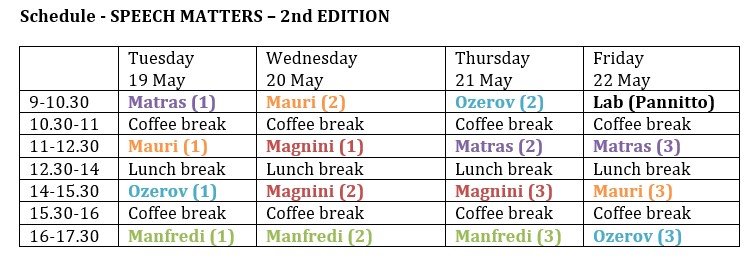
Course 1 – Layers of cooperation: The interactional architecture of spoken language
Prof. Caterina Mauri – Alma Mater Studiorum, Università di Bologna
This lecture series investigates how the structure of spoken language emerges through the cooperative dynamics of face-to-face interaction. Speech unfolds enchronically—turn by turn, action by action—and is shaped by participants’ continuous coordination (Enfield 2009; Levinson 2006). We will discuss how linguistic organization adapts to this temporally situated, interactionally contingent environment by addressing multiple layers of cooperation, each corresponding to different types of linguistically relevant interactional work.
Cooperation is first observable in the management of interaction itself: regulating turn-taking, signalling availability for uptake, handling overlap, and initiating repair (Sacks et al. 1974; Stivers et al. 2009). These mechanisms maintain the temporal structure of conversation and enable the emergence of more complex joint actions and their sequential organization (Schegloff 2007; Kendrick et al. 2020).
Another dimension concerns epistemic and affective alignment: speakers display agreement or dissent, alignment or distance, through lexical, prosodic, and grammatical cues. These forms of cooperation serve to calibrate speaker commitment and interpersonal positioning (Du Bois 2007; Pietrandrea 2018), and contribute to building a shared perspective on what is being said.
At the center of the cooperative architecture lies the negotiation of reference and categorization. Speakers collaborate to establish what they are talking about, often through reformulations, clarifications, exemplifications, and context-sensitive categorization strategies (Clark & Brennan 1991; Mauri & Sansò 2018; Ariel & Mauri 2018). This domain is foundational: without referential alignment, further interactional work—such as topic development or narrative progression—cannot proceed. As highlighted by Voghera (2017), reference is not a fixed function of grammar but an evolving interactional process, shaped by the discourse status of the referent and by mechanisms such as repetition and reformulation. We treat reference and categorization not as static structures but as interactional achievements, often distributed across turns and speakers (cf. also Deppermann & De Stefani 2018). These dynamics are reflected in the syntax of spoken language, which frequently shows signs of co-construction. Fragments, ellipses, expansions, and completions often result from interactional processes rather than individual sentence planning (Du Bois 2014; Deppermann & De Stefani 2018; Auer 2009). Syntax in spoken interaction is therefore a site where cooperative patterns are encoded and made visible, and where structure emerges incrementally in response to ongoing interaction.
Throughout the series, examples from spoken corpora will be used to illustrate how speakers rely on these layered forms of cooperation to build meaning, manage participation, and shape linguistic structure in real time. Cross-linguistic insights will help highlight the typological variation and universality of these mechanisms. The aim is to show how grammar, reference, and discourse organization are shaped not only by the needs of representation, but also—and crucially—by the demands of interaction.
***
Course 2 – Multimodal and dynamic information management in natural interaction
Prof. Pavel Ozerov – Universität Innsbruck
In classical models of information structure, speakers communicate by sentences updating the common ground. The information conveyed by a sentence is partitioned into an updating/foregrounded, potentially contrastive part (“focus”) and the presupposed, backgrounded one. Commonly, one finds additional delineable informational roles, such as an entity taken as the pivot for the rest of the message (“topic”). However, an application of this model to natural interaction faces challenges that suggest the need for an approach rooted in dynamic and multimodal nature of spoken language. Research of spontaneous discourse demonstrates that an assignment of an informational role on the level of a complete sentence cannot represent a realistic model of information processing for the speaker or the receiver. Instead, speakers dynamically increment syntactic structures without envisioning the entire product in advance. In addition, interactants face many tasks beyond conveying the backgrounding or updating role of verbal content. They seek the right to speak, get others’ attention, monitor comprehension, and use multimodal signs to signal the role of information.
This class will overview the multimodal processes of dynamic information management in natural multimodal interaction. Using multimedia corpora of spontaneous conversation from Sino-Tibetan and Semitic languages, we will recast the process of information management into low-level communicative instructions and moves accomplishing local interactional goals, such as attention alignment. Classical categories of information structure emerge in this view as a rough generalization of diverse interactional instructions and local moves. Some of the typical examples of information structuring constructions and markers turn out upon multimodal examination to represent interactional phenomena only epiphenomenally giving rise to topical or focal effects. At the end of the class, the participants will acquire the basic toolkit required for the examination of dynamic information management in the language of their expertise.
***
Course 3 – Language contact in speech
Prof. Yaron Matras, Aston Institute for Forensic Linguistics
The series of four lectures will aim to explore theoretical implications of a functional-typological and discourse-based analysis of speech, drawing on corpora of conversations in a variety of multilingual settings. We first examine the challenge of distinguishing Codeswitching and Borrowing, framing the two concepts as two idealised poles on a continuum. In the second lecture we examine bilingual speech production errors around so-called ‘utterance modifiers’ or discourse markers and related items. Taking a discourse analytical approach, we consider theoretical implications for a typology and possible universals of contact induced language change, for a general theory of language contact, as well as for a theory of the evolution of the language faculty itself. In the third lecture we draw examples from discourse in order to review critically notions of contact languages such as Pidgins and Creoles, Mixed Languages and Heavy Borrowing. We consider the merits of a focus on process and the functionality of particular forms of interaction, rather than on essentialised structural features as the basis of categorisation. In the fourth and final lecture we return to the notion of Mixed Languages and examine from a discourse perspective the functionality of lexical and other insertions considered to be constitutive of in-group mixed registers.
***
Course 4 – Integrating Linguistic Fieldwork, the Ecology of Language, and Ecolinguistics: The Case of AlUla (KSA)
Prof. Stefano Manfredi, CNRS, SeDyL, Paris
This series of three lectures explores the intersection between linguistic fieldwork and theoretical models in the Ecology of Language and Ecolinguistics, using data from fieldwork conducted in 2025 within the project The Linguistic Ecology of AlUla (LEAlUla): Urbanization and Language Change in North-Western KSA. The first seminar introduces theoretical and methodological foundations in the study of the Ecology of Language and Ecolinguistics, with an emphasis on the role of fieldwork in analyzing dialect variation in complex sociolinguistic environments. Haugen’s (1972: 325) definition of the Ecology of Language as “the study of the interactions between any language and its environment” provides the starting point for examining how Arabic dialects in AlUla reflect different systems of production and ongoing ecological transformations. The key property of any Linguistic Ecology lies in its structured diversity (Mühlhäusler 1996a), which is defined “not so much in terms of numbers but in terms of the quality of meaningful interrelationships” between “species of different languages” (Mühlhäusler 1996b: 206). In this sense, AlUla represents an ideal accretion zone, where dialects coexist with low degrees of structural mixing. The methodological discussion will highlight how fieldwork techniques—such as sociolinguistic interviews, dialect mapping, and historical-linguistic reconstruction—contribute to the analysis of dialect contact and differentiation in an evolving linguistic ecology.
The second seminar focuses on linguistic ecologies as analytical frameworks for understanding dialect contact and change. AlUla’s linguistic ecology is shaped by the coexistence of sedentary and nomadic production systems, which historically fostered distinct Arabic dialect groupings. However, processes of sedentarization and urbanization are reshaping these dialect boundaries. In AlUla, dialect contact does not occur between local varieties; instead, dialect leveling and language shift take place in favor of the national variety, leading to a gradual loss of local dialectal distinctions rather than the formation of a stable linguistic ecology through mutual convergence. This seminar examines how fieldwork data can be used to trace patterns of dialect interaction, retention, and change, providing insights into the broader relationship between socio-economic transformations and language evolution.
The third seminar turns to ecolinguistics and the relationship between language inheritance and ecological knowledge, exploring how traditional practices tied to date palm farming and camel herding are embedded in specific linguistic forms and conceptual frameworks. Steffensen (2007) argues that ecolinguistics should not be reduced to language documentation alone but must incorporate broader ecological systems, recognizing the interdependence between linguistic and environmental diversity. The decline of pastoralist traditions and the transformation of agricultural livelihoods in AlUla raise critical questions about the erosion of domain-specific lexicons and speech genres, particularly in relation to environmental knowledge. This seminar examines the extent to which dialect loss or change corresponds to shifts in ecological knowledge, addressing both the implications of language endangerment and the potential for ecolinguistic approaches to contribute to environmental preservation.
***
Course 5 – Modeling Collaborative Behaviors in Task-oriented Dialogues with Large Language Models
Prof. Bernardo Magnini, Fondazione Bruno Kessler – Trento
The use of Large Language Models (LLMs, e.g., ChatGPT) is now pervasive in all areas of Artificial Intelligence (AI). Applications involving language generation, as, for instance, human-machine conversations, are a privileged area of investigation for generative AI. The course introduces LLMs and presents several methodologies aiming at assessing the ability of LLMs to model human collaborative behaviours in task-oriented dialogues. As a case study, we investigate “proactivity”, a characteristic phenomenon of collaborative human-human interaction, where a participant in the dialogue offers the addressee some useful and not explicitly requested information.
The course will offer the opportunity to learn core notions about LLMs (e.g., continuous representations of word meaning, transformers and attention, in-context learning), and to understand how LLMs can be applied to model properties of task-oriented dialogues (e.g., dialogue acts, communication goals), including pragmatic phenomena (e.g., dialogue coherence, proactivity).
***
Lab – Hands-on Speech Corpus Processing: Standardization, Automation, and GitOps for Reproducibility
Dr. Ludovica Pannitto, Alma Mater Studiorum, Università di Bologna
Processing spoken data presents unique challenges due to its complexity and multi-layered nature, requiring synchronization across audio, transcription, annotations, and metadata. Ethical considerations, such as GDPR compliance, further complicate data management. Additionally, maintaining consistency across various tools and formats is crucial for ensuring accessibility, interoperability, and long-term usability, and current practices often place most of the burden on a few individuals with specialized knowledge, making data access, versioning, and reproducibility fragile.
This lab provides a hands-on approach to the pre-processing and management of speech corpora, focusing on automation, reproducibility, and collaborative workflows. Participants will explore NLP tools, UD-compliant resource creation, and GitOps methodologies to enhance version control, peer review, and quality checks in corpus processing. Practical sessions will cover best practices for ensuring data integrity, handling incremental dataset releases, and integrating diverse tools through APIs. By the end of the course, attendees will gain a general overview of how to build robust, maintainable, and FAIR speech corpora using modern computational and open-source principles.