
Speech Matters - 2nd Edition
May 19-22, 2026


This School is the second edition of Speech matters, which was successfully held at Villa del Grumello in May 2022, attracting around forty participants from a variety of international backgrounds. Building on the positive experience and feedback of the first edition, this new edition aims to further strengthen the dialogue between sociolinguistics, computational linguistics, linguistic typology, language documentation, and corpus-based approaches by exploring how recent methodological advances can foster greater integration across these fields.
The first edition of the School was grounded in the idea that spoken language offers an essential vantage point for rethinking current models of ‘standard’ grammar. Such models have often paid limited attention to spoken data, aside from occasional acknowledgments that specific patterns may diverge from those found in written or standardized language. This neglect of the spoken modality reflects more the historical assumptions about what a grammarian should study than any inherent limitation of grammatical models themselves in accounting for speech and extended discourse. As a result, insights from research on spoken language – across fields like sociolinguistics, interactional linguistics, and discourse analysis – are seldom incorporated into broader models of human communication, despite their potential to reshape our understanding of grammar. These insights are also relevant for speech technologies, whose effectiveness depends heavily on access to realistic, task-specific training data and on accurate modeling of spoken interaction.
Indeed, in speech, not all linguistic choices are equally probable. Speakers tend to select structures and patterns that are well-suited to the spoken modality, whether due to cognitive efficiency or social appropriateness. This gives rise to cross-linguistically recurrent features that can be described as modality-specific constraints – i.e., features that consistently appear in spoken texts across different languages. These are not simply a consequence of the vocal-auditory channel but rather emerge from the complex semiotic and communicative conditions in which spoken discourse typically unfolds. They often involve linguistic or discourse features with a high yield factor, that is, elements optimized to support both the production and comprehension of speech.
The School aims to bring together scholars working on spoken language from diverse perspectives, with the goal of fostering dialogue among disciplines such as linguistic typology, sociolinguistics, discourse analysis, prosodic analysis, and natural language processing. The novelty of this initiative lies precisely in its commitment to promoting meaningful cross-fertilization among fields that share spoken language as their primary object of study, but that often rely on distinct methodologies and pursue different research aims.
A beautiful location
Lake Como School of Advanced studies is located c/o Fondazione Alessandro Volta in the beautiful setting of Villa del Grumello, in Como, Italy
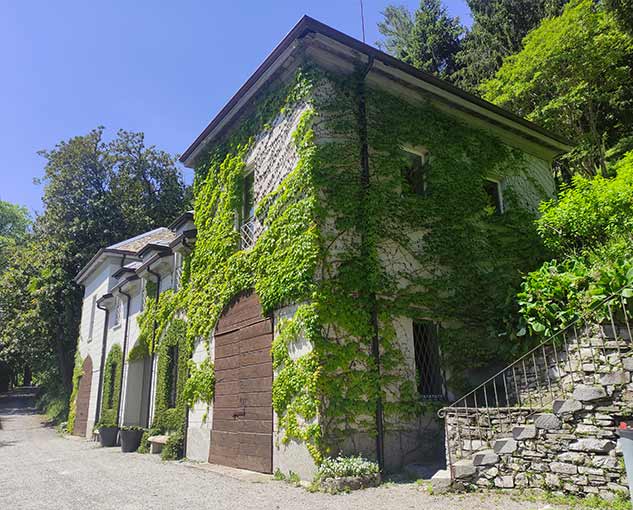
Venue & Accommodation
The Lake Como School of Advanced Studies is an international research facility. We run fellowships, short term programmes on a wide range of interdisciplinary subjects, that share a common focus on complex systems.